
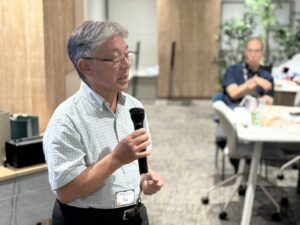
Ted Agatsuma founded our club in 2011, when it was called Shinagawa Toastmasters Club. He has been a Toastmaster for 40 years. We asked him how the club began, what kept it alive, and why it exists.
Interviewed September 2026
How It Started
How did you first discover Toastmasters?
In 1986, when I was 34, a senior colleague took me to Tokyo Toastmasters Club. Back then, there were very few places in Japan where people could speak English casually. I was deeply impressed by the warm, supportive atmosphere and joined right away.
You were already a member of Tokyo TMC. Why start another club?
I was the Training and Organization Development Coordinator in my company’s HR department. Our French CEO came to me with a challenge. Our Japanese employees were highly capable, yet few of them held leadership roles across the Asia region, and he believed communication was what held them back. When he asked if I had a solution, I told him a Toastmasters club was the ideal answer.
We first planned a club only for our own employees. As the idea developed, we realized that opening it to the public would bring more diversity, fresh perspectives and a richer learning environment for everyone.
What was the club like at the very beginning?
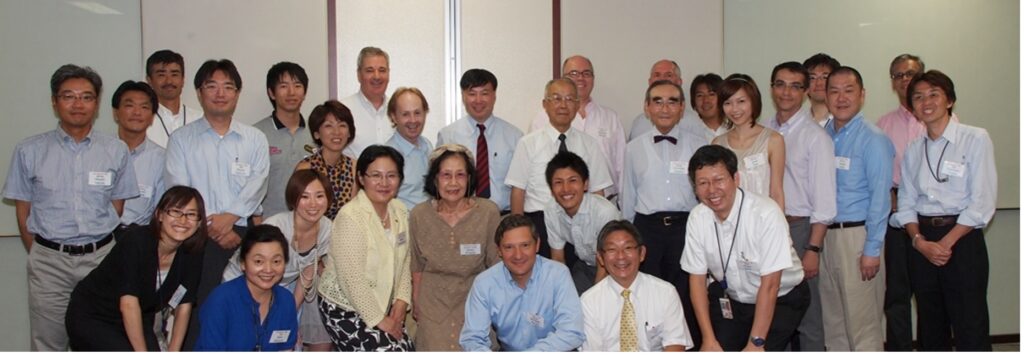
We met in an 18th-floor conference room at ExxonMobil Japan’s Shinagawa office. Our first 25 or so members were ExxonMobil employees, members of Tokyo TMC, District 76 leaders and Toastmasters from clubs across the Kanto region. Everything was on paper.
It all came together remarkably fast. We held a demonstration meeting on December 8, 2010, became a provisional club on January 12, 2011, and chartered as Shinagawa TMC on March 18, 2011. That was just over four months, and exactly one week after the Great East Japan Earthquake. It was one of the hardest times to run anything in Japan, but our members rallied and kept meeting. Overcoming a crisis that big at our very beginning gave us tremendous confidence for the future.
The Club He Wanted to Build
What kind of club did you want OTMC to become?
Our first goal was to help employees communicate better. But I imagined something broader: a diverse, open and sustainable club where people from all backgrounds could grow together over the long term. We wanted a high-quality venue, members from many industries, a real mix of genders, generations and nationalities, and speeches on thought-provoking topics.
What did you want a nervous first-time guest to feel?
I wanted every guest to feel genuinely welcome from the moment they walked in. I pictured members reaching out to newcomers first, so the room felt fun, warm and friendly, and anyone could relax right away.
The Hard Years
Was there a time the club almost didn’t survive?
Yes. In 2014, ExxonMobil Japan moved its office from Shinagawa to Otemachi, in the same year I retired from the company. The club lost its home and its founder at the same time, and its future was in real doubt. The Executive Committee stepped up, moved the club and renamed it Otemachi Toastmasters Club. The real heroines and heroes of that period were the leaders on the ground.
And the pandemic?
COVID-19 was our most difficult period. Toastmasters relies so much on in-person energy and stage presence that moving to Zoom was a big shift. But going online didn’t just keep us alive. It showed how committed our members were to staying connected.
Why OTMC Exists
After 40 years in Toastmasters, what really helps people improve?
Two things. Stay grounded in the Toastmasters fundamentals, and keep running meetings where people leave energized and glad they came. Build a place where it’s safe to make mistakes, and leadership and speaking skills follow naturally.
Describe OTMC’s culture in three words.
Friendly, ambitious and respectful. That’s how I see it, anyway. Culture is a living thing, so I’d love to hear how today’s members would describe it.
What surprises you most about OTMC today?
How naturally the club uses technology, from Zoom meetings onward. And how much richer it became after we left the company and opened fully to the community. Today I see people of many backgrounds, nationalities and generations learning from one another. Yet the friendly, energetic, supportive atmosphere is exactly the same as in 2011.
Is there a member’s story that captures what OTMC means to you?
Hosting Area and Division contests, and producing a finalist for the International Speech Contest, have made us very proud. On a personal level, serving as Carlos’s mentor and watching his journey represents everything OTMC means to me: helping each other find hope and reach heights we never thought possible.
If someone reads this on OTMC’s 30th anniversary, what should they know about why the club exists?
OTMC exists to empower people. It was founded on the belief that effective communication builds bridges and opens doors. OTMC is not about being a competent speaker from day one. It exists to provide an encouraging environment where everyday people can grow into confident leaders.
And one last question. A nervous guest walks in and says, “I’m terrible at public speaking.” What do you say?
I would smile and say, “Welcome! You’re in the best place. Almost every confident speaker in this room started exactly where you are today. Toastmasters is where we learn by making mistakes together.“
Come See It for Yourself
We meet on the 2nd and 4th Wednesday of each month, 7:00 to 9:00 p.m., near Tsukiji Station. Guests are always welcome.